

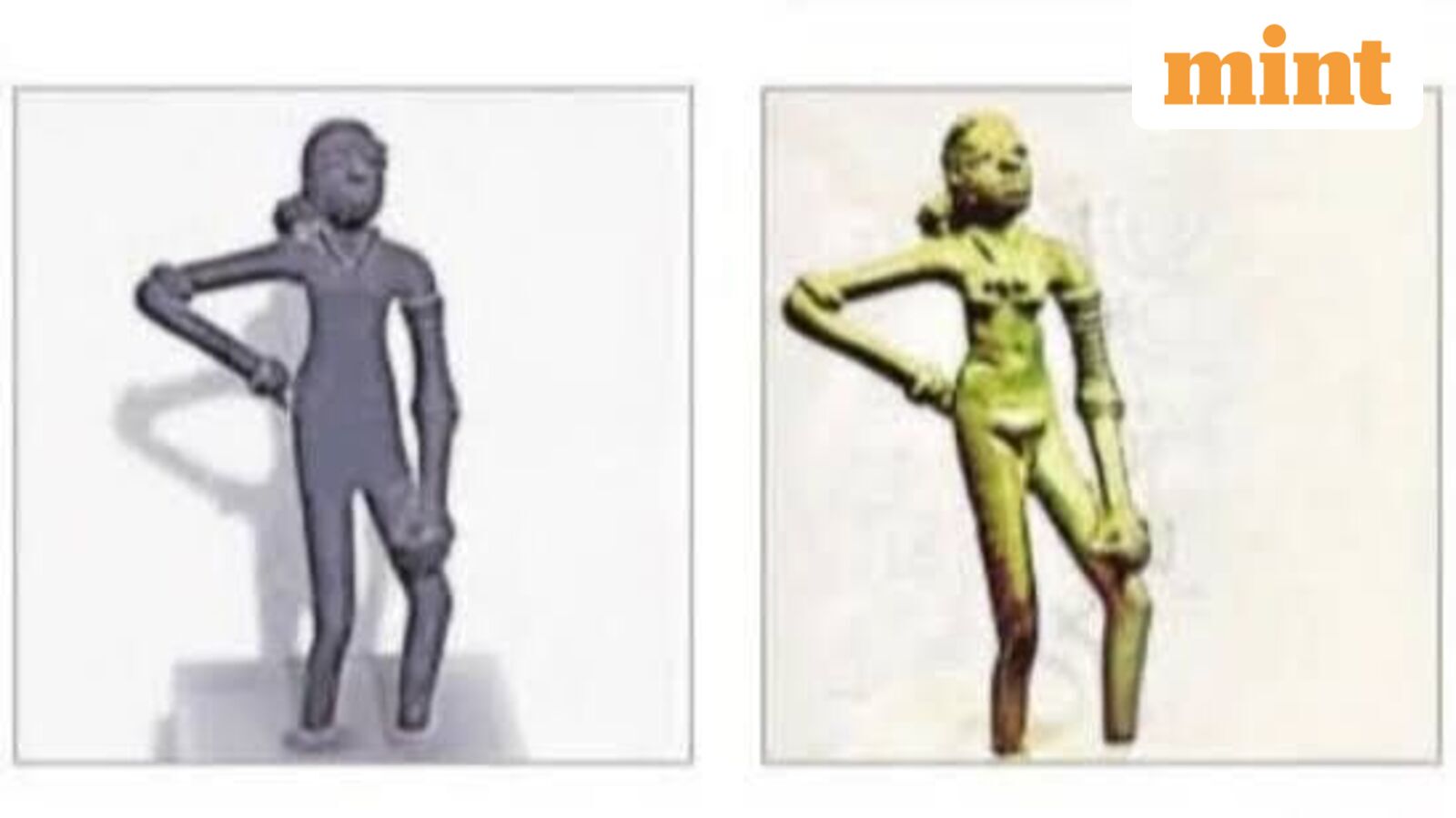
The National Council of Educational Research and Training (NCERT) on Monday decided to replace the altered depiction of the famous Mohenjo-daro ‘Dancing Girl’ sculpture in its Class 9 Arts textbook in the opening chapter, “History of Arts”, of Madhurima, with the original image after facing backlash over the figurine being shown with added clothing.
The decision was taken after a review by the Department of Arts Education and the Textbook Development Committee, according to Times Of India citing sources.
Historian Michel Danino, who headed the textbook development committee for NCERT’s new Class 6 Social Science books, revealed his first reaction was one of “disbelief”, calling it “not age-appropriate”.
“This refers to our Grade 6 Social Science textbook. The reason I was given was that the image of the Dancing Girl was not ‘age-appropriate’, Danino told PTI.
“Our team disagreed; we even checked with teachers of Class 6, and they told us there was never a problem with the Dancing Girl. The notion that nudity is inappropriate is, in my opinion, an obsolete Victorian view. Yet we speak of decolonising Indian education,” he mentioned.
Danino said, “If the Dancing Girl cannot figure as she is, and with proper dimensions, in a chapter on Indian art, then we have a serious problem,” adding that the modification “misrepresents the original artefact”.
“The modification misrepresents the original artefact just as the Church’s addition of a fig leaf to Michelangelo’s statue of David in the Middle Ages misrepresented that beautiful work of art,” he added.
Discussing the significance of the figurine, Danino said scholars have proposed various interpretations over the years, as its exact context remains uncertain. He pointed out that the same akimbo stance appears on at least two potsherds discovered at the Harappan site of Bhirrana in Rajasthan, indicating that it carried “a precise cultural value, probably an artistic one”.
Danino also objected to the modification of images of historical artefacts, arguing that such changes can misrepresent the original object.
“Unless this is clearly done to indicate the possible reconstruction of a partial artefact, altering such an image amounts to creating a fake artefact. It points to a serious lack of understanding of how historical artefacts are to be pictured,” Danino said.
The decision follows a controversy surrounding the portrayal of one of the most well-known artefacts of the Indus Valley Civilisation in educational materials, sparking discussion about the accuracy of its representation in school textbooks.
In contrast, the image of the “Dancing Girl” featured in NCERT’s Class 6 Social Science textbook closely resembles the original bronze artefact and retains its authentic appearance.
NCERT Director reacts
NCERT Director Dinesh Saklani said the matter was addressed as soon as it was brought to the organisation’s attention, with the concerned department instructed to examine the issue.
“As soon as the issue came to notice, the concerned department was directed to look into the matter. Following consultations with experts, the department is replacing the image of the Dancing Girl with its original version. The correction is being implemented immediately in the digital version of the textbook, while the revised print editions will carry the original version of the image,” Saklani told ANI.
What does the textbook say?
The chapter describes the ‘Dancing Girl’ as a bronze figurine unearthed at Mohenjo-daro and dating back to approximately 2600 BCE.
According to the textbook, the sculpture was created using the “lost-wax technique prevalent in West Bengal, Jharkhand and Chhattisgarh.”
“This sculpture depicts a posture with one knee bent, one hand on the waist and a slightly lifted chin,” the text states.
The chapter also features a discussion question that encourages students to interpret the figurine’s pose. In addition, an activity invites students to imitate the stance and draw it while imagining different placements of the feet.
The ‘Dancing Girl’, discovered at the archaeological site of Mohenjo-daro, is regarded as one of the most iconic artefacts of the Indus Valley Civilisation.