

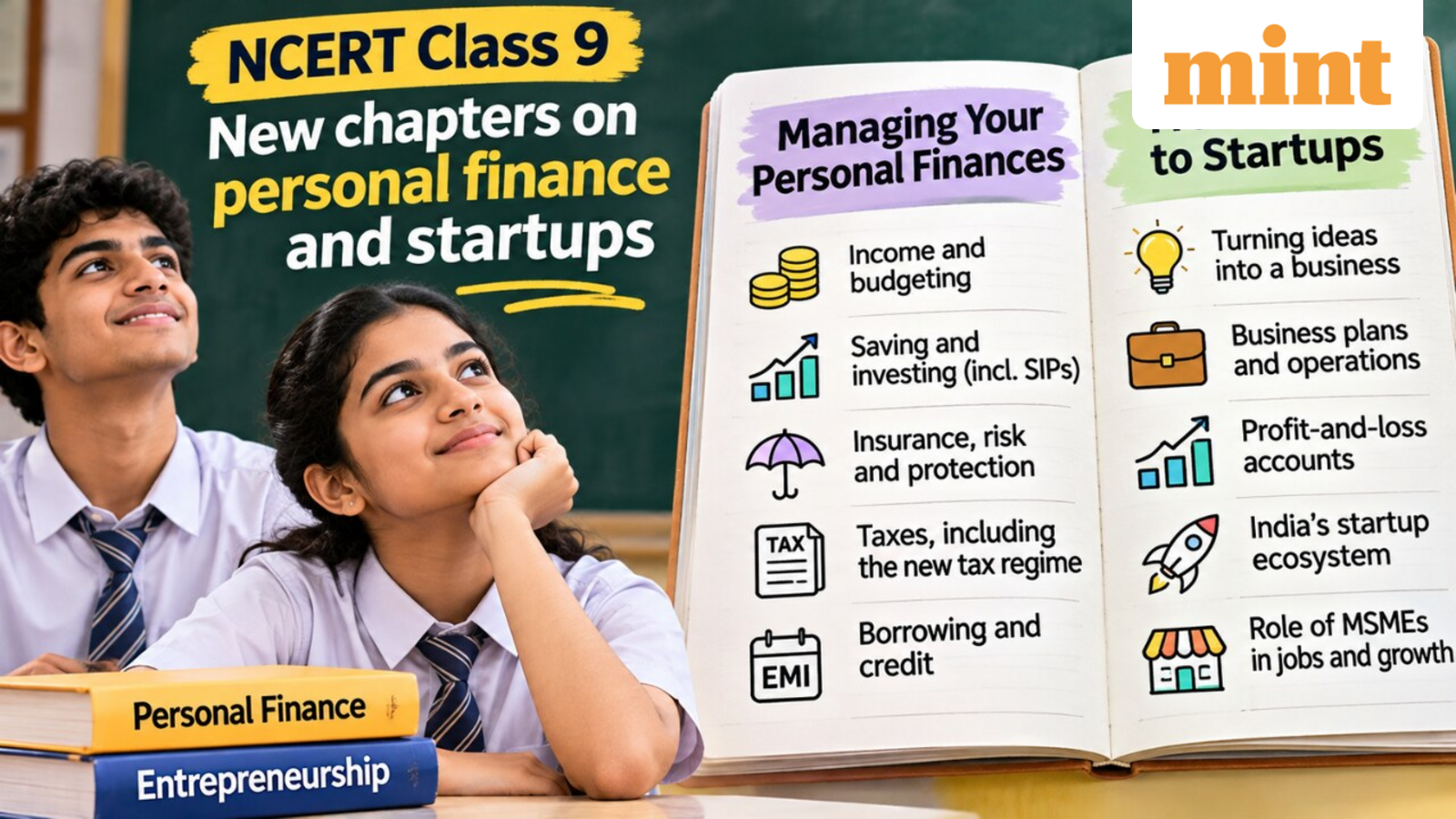
Students entering Class 9 will now learn about mutual funds, fixed deposits, taxes, loan repayments and even how to set up a business, as the National Council of Educational Research and Training (NCERT) introduces dedicated chapters on personal finance and entrepreneurship in its new Social Science textbook.
The two chapters, included in the Economics section of the Class 9 Social Science textbook, aim to familiarise students with financial decisions and the basics of running a business. Titled ‘Managing Your Personal Finances’ and ‘From Ideas to Startups’, they cover subjects ranging from budgeting and investments to business plans and profit-and-loss accounts.
The additions come at a time when investing through systematic investment plans (SIPs) has become a prominent part of India’s retail investment landscape. While digital platforms have made investing more accessible, financial influencers and social media content have also brought investment-related discussions into everyday conversations.
Mutual fund SIP contributions reached ₹32,490 crore in September 2026, according to a report by Business Standard. This came even as benchmark indices such as the Nifty and Sensex recorded negative returns over the period since September 2024, without a corresponding decline in SIP inflows.
What will students learn about personal finance?
The chapter ‘Managing Your Personal Finances’ introduces students to five fundamental areas of money management – income, budgeting, saving, investing, and protection and risk management.
Students will learn about different savings and investment avenues, including fixed deposits, government savings schemes, bonds, stocks and mutual funds. The chapter also explains concepts such as inflation, compounding and the relationship between investment risks and returns.
The lessons extend to insurance, borrowing, credit and equated monthly instalments (EMIs). Students will also be introduced to taxation, including the distinction between direct and indirect taxes and the income-tax slab structure under the new tax regime. Worked examples have been included to help them understand how tax liability is calculated.
The chapter begins with familiar situations involving money. Students are encouraged to think about how they use pocket money or cash received from relatives during festivals, whether they save it or spend it immediately, and how they manage everyday expenses such as travel, stationery and food at the school canteen.
It also asks them to consider whether they plan their spending to save for something they want to do later.
How will students understand investments and risk?
The chapter introduces students to the relationship between risk and returns, explaining that investments carrying lower risks generally offer lower returns, while those involving higher risks may offer the possibility of higher returns.
It also highlights that investment decisions should depend on an individual’s financial goals, willingness to take risks and the time when the money may be needed.
What will students learn about taxes?
The textbook explains taxation as a compulsory payment made by individuals and businesses to the government to fund public services and essential facilities such as schools, hospitals, transport and defence.
It introduces three categories:
Direct taxes: Payments made directly by individuals or organisations on income or profits. Income tax is one example.
Indirect taxes: Taxes included in the prices of goods and services, such as the Goods and Services Tax (GST).
Personal income tax: Tax paid on an individual’s earnings during a financial year, which runs from 1 April to 31 March. Those earning below the prescribed exemption limit are not required to pay income tax.
From ideas to startups: What will the entrepreneurship chapter cover?
Alongside personal finance, NCERT has introduced a chapter titled ‘From Ideas to Startups’ to familiarise students with entrepreneurship and its role in society and the economy.
The chapter uses a practical classroom exercise to explain how a business works. Students are asked to imagine that their school is hosting an annual festival and they are taking part in a Young Entrepreneurs Challenge. They decide to set up a lemonade stall for parents and children visiting the event.
What are the four functional areas of a business?
The entrepreneurship chapter also introduces students to four broad functions that help a business operate and grow.
Management and operations: Covers the day-to-day running of a business, including production, quality control and supply chain management.
Finance and accounting: Focuses on budgeting, financial reporting, cash flow management and maintaining a business’s financial health.
Human resources: Deals with managing employees, recruitment, employee benefits and workplace conflicts.
Marketing and sales: Explains how businesses promote their products and services, build customer awareness and generate sales.
Why has NCERT introduced these changes?
The new chapters are part of a wider revision of school textbooks and curricula under the National Education Policy (NEP) 2020 and the National Curriculum Framework for School Education (NCF-SE) 2023.
The revisions seek to bring emerging subjects such as artificial intelligence and computational thinking into school education, alongside a greater emphasis on vocational learning and practical skills.
The latest additions to the Class 9 Economics curriculum were highlighted by Sanjeev Sanyal, a member of the Prime Minister’s Economic Advisory Council, in a post on X on Wednesday.
Sanyal said the personal finance chapter would familiarise students with concepts such as fixed deposits, mutual funds, EMIs, taxes and the relationship between risk and returns, describing these as useful life skills.
He also pointed to the entrepreneurship chapter’s focus on business plans and profit-and-loss accounts, and its approach to presenting business, innovation and risk-taking positively.
Sanyal said this was different from the approach of earlier textbooks, which, according to him, placed greater emphasis on subjects such as hoarding and black markets.