

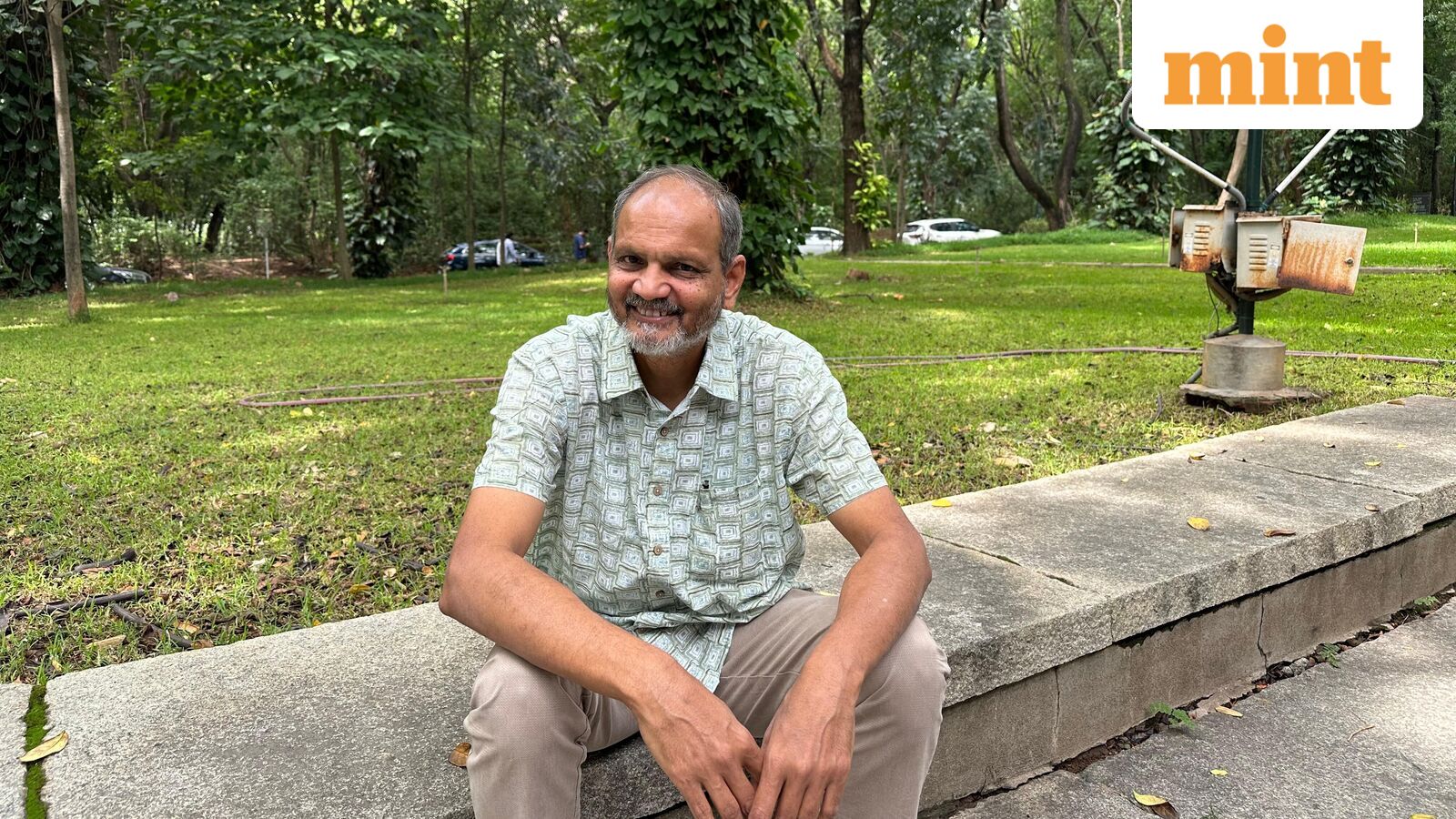
What began as a PhD student’s frustration while watching Spanish films in the United States three decades ago has today evolved into a nationwide literacy movement that is shaping India’s broadcasting policy on subtitling.
In an interview with Mint, Brij Kothari, who leads BIRD, or the Billion Readers initiative, traces the remarkable three-decade journey of Same Language Subtitling (SLS), the idea of displaying subtitles in the same language as the audio, such as Hindi subtitles on Hindi films or Tamil subtitles on Tamil programmes.
Today, after years of resistance, research and policy advocacy, over 110 television programmes in India carry SLS, reaching an estimated 160 million viewers, Kothari says. The initiative is also becoming mandatory for films and streaming platforms.
How was the idea born?
Kothari grew up in Puducherry, studied at the Sri Aurobindo International Centre of Education (SAICE) and later went to Indian Institute of Technology, Kanpur (IIT-K).
Kothari says that the idea of Same Language Subtitling (SLS) struck him firts in 1996 while pursuing his PhD at Cornell University, United States. While watching Spanish films to improve his language skills, he found himself wishing the spoken Spanish also appeared as subtitles.
“I thought, if listening and reading happen together, reading skills would improve. Then I asked myself: why not Hindi on Hindi, Tamil on Tamil and every Indian language on itself?” he recalls.
When he searched the academic literature, he discovered that subtitles had traditionally been viewed only as an accessibility tool for the deaf and hard of hearing—not as a literacy intervention.
“I realized nobody had ever used subtitles to improve reading,”said Kothari, who is Adjunct Professor at the School of Public Policy, IIT Delhi.
“You listen and read at the same time.”
Taking the idea to India
After joining IIM Ahmedabad in August 1996 as a faculty member, Kothari began researching what he called Same Language Subtitling, deliberately avoiding the term ‘captions.’ Kothari is credited for coining the term – ‘Same Language Subtitling’
His first experiments were surprisingly simple. The team placed two televisions at railway stations, showing Gujarati songs — with subtitles on one screen and without subtitles on the other — and asked viewers which they preferred.
“The surprise was that people actually preferred the version with subtitles because they could sing along and read,” he said.
Kothari took the idea to TV channels. But despite positive public response, television broadcasters rejected the concept. “They told us subtitles would distract viewers, and weak readers wouldn’t read them anyway,” he said.
A $250,000 World Bank award
Instead of giving up, Kothari decided to generate scientific evidence. His team conducted controlled studies in Ahmedabad municipal schools, exposing one group of children to subtitled content while another watched programmes without subtitles.
“The children who watched subtitles consistently developed reading skills faster,” he said.
That evidence would eventually become the foundation of decades of advocacy.
Eventually, Kothari entered the idea into the World Bank’s Development Marketplace competition. In 2002, the project won the Global Innovation Competition’s top prize of $250,000 from Co-Impact.
“We were shocked that someone was willing to invest so much in this idea,” he said. The recognition gave the initiative international credibility.
Co-Impact brings together local changemakers and funders from around the world to make health, education, and economic systems stronger and more inclusive.
Armed with evidence and funding, Kothari approached Doordarshan. Most officials opposed the proposal. But then Director General SY Quraishi overruled his staff, who asked, ‘Has anyone tried this before? If not, how can you say it won’t work?'”
Doordarshan agreed to subtitle episodes of Rangoli, one of India’s longest-running music shows. The experiment lasted seven years. Researchers tracked viewers over time and found that regular viewers demonstrated measurable improvements in reading ability. Rangoli is still broadcast on Sundays.
But the education department was not keen on adopting it. The officials believed it had nothing to do with literacy and instead that television should do it.
Progress slow, but significant
The breakthrough finally came in 2019, when the Doordarshan Director General, Supriya Sahu , backed the proposal.
According to Kothari, Sahu understood both its educational and public-service value and pushed for a policy through the Ministry of Information and Broadcasting.
The result was a national policy recommending that 50% of television entertainment programming carry same-language subtitles.
But implementation has lagged behind policy ambitions and is starting to roll out in 2025. Kothari said fewer than 5 per cent of eligible television programmes currently comply.
Still, progress is visible. Today, around 110 programmes across television networks carry SLS, collectively reaching roughly 160 million people, providing an estimated one to two hours of daily reading practice in viewers’ own languages, Kothari said.
“We don’t tell people what to watch,” he says. “We simply make what they already watch an opportunity to read.”
Kothari says the next challenge is quality. His organisation now works with broadcasters such as Dangal TV to improve subtitle design using principles that benefit weak readers — larger fonts, better spacing, clearer shadows and improved readability.
The Pathan Breakthrough
“What works for weak readers actually works for everyone,” he says.
The movement funded through Kothari’s non-profit PlanetRead, has now expanded beyond television. Since March 2026, every film seeking certification from the Central Board of Film Certification (CBFC) must submit a same-language subtitle file, along with accessibility features such as audio description.
The policy emerged after the disability rights advocacy group ‘Mission Accessibility’ successfully challenged the film industry’s accessibility practices in court. Shah Rukh Khan-starrer Pathan was the first Indian-language movie mandated to include both audio description and same-language subtitles (SLS).
The Ministry framed guidelines. And now streaming platforms are also being brought under similar rules, Kothari says.
“We want each movie to have subtitles in the same language. The translation part should be for the market to decide,” Kothari said.
Why India could lead the world
Kothari argues India has become the first country to view subtitles not merely as an accessibility tool but as a literacy intervention. Most countries adopted subtitles primarily for deaf and hard-of-hearing audiences.
India, he says, is attempting something much broader.
“In a multilingual country like India, same-language subtitles can improve reading, support language learning and enhance accessibility, all at the same time,” Kothari says.
We simply make what they already watch an opportunity to read.
He believes subtitles could transform literacy by seamlessly integrating reading into everyday entertainment. “Whether people realise it or not, if they keep watching programmes with same-language subtitles, they will become better readers,” he says.
After nearly 30 years of research, advocacy and policy battles, Kothari says the goal remains unchanged: to make reading practice as effortless and as enjoyable as watching television.